
Bitcoin Dada at 4: How One Community Unlocked My Bitcoin Journey
There are communities you join for information. And then there are communities you join, and something in you simply unlocks.
For me, that community is Bitcoin Dada.
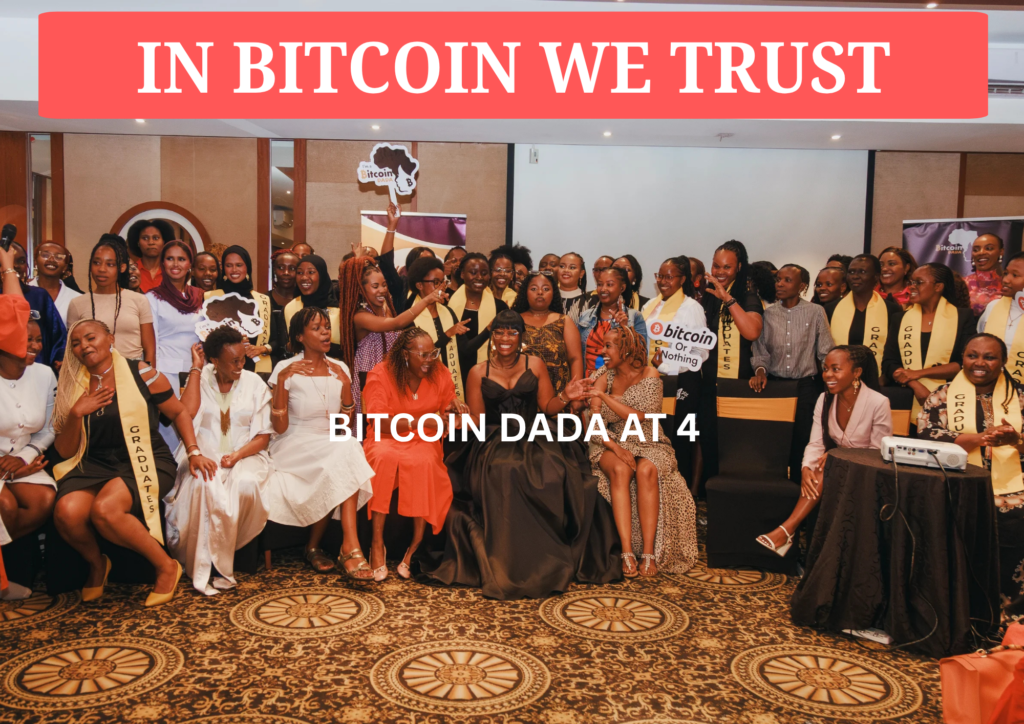
On May 16, 2026, I had the honour of standing in a room full of extraordinary women to celebrate Bitcoin Dada’s 4th anniversary — and to share what this community has meant to my journey. Four years of building, teaching, connecting, and refusing to let African women be an afterthought in the Bitcoin conversation. It is a milestone worth celebrating loudly.
But to explain why it matters so much to me personally, I need to take you back to where I started — and be honest about how difficult that beginning actually was.
Bitcoin, Blockchain, and Why the Difference Matters
Before I found Bitcoin Dada, I was a Web2 developer ( Well, I still am) making my way into Web3, curious, ambitious, and somewhere in the middle of figuring it all out.
Here is something that surprises many people just entering the space: blockchain technology and Bitcoin are not the same thing, and blockchain did not begin with Bitcoin.
The concept of a cryptographically secured chain of records dates back to 1991, when researchers Stuart Haber and Scott Stornetta first proposed a system for tamper-proofing digital timestamps. The foundational ideas of distributed ledgers stretch even further, to cryptographer David Chaum’s 1982 dissertation and to the Byzantine Generals Problem described in that same era, which explored how trust could be achieved across a decentralised network of participants who could not fully trust each other.
What Satoshi Nakamoto did in 2008 was not invent blockchain from nothing. What Nakamoto did was take those existing ideas, cryptographic hashing, distributed consensus, peer-to-peer networking — and integrate them into a coherent, working system for the first time. Bitcoin was the first successful application of blockchain technology.
That distinction matters in practice. Because it means blockchain is a tool and Bitcoin is one of the most powerful and enduring things ever built with it. When I started learning to build on other chains like Solana and Ethereum, I was working with later iterations of that tool. Coming to Bitcoin meant going back to the application that proved the whole idea could work and building on infrastructure that nobody owns and nobody controls.
The Problem With Building on Other Chains
I want to be honest about something that does not get discussed enough in blockchain education circles.
Many blockchain companies have a fundamental conflict of interest. Their primary goal is to grow their own chain — to get developers building on it, to generate activity, to attract users and capital. That incentive means their energy goes into ecosystem growth, not developer experience. Incentives are offered here and there, but the experience of actually learning to build on those chains? For many of us, it was isolating, confusing, and deeply unsupported.
Bitcoin is different in one critical way: nobody owns it.
There is no company behind Bitcoin. No foundation with a financial interest in growing “the chain.” No venture capitalists whose returns depend on keeping developers dependent on their ecosystem. Bitcoin is open-source, decentralised, and maintained by a global community of contributors who are there because they believe in what it represents not because they are paid to be.
When there is no self-interest at the centre, the experience of building changes fundamentally. And I did not fully understand that until I built on Bitcoin.
My First Attempt Was a Disaster — And Nobody Helped
My introduction to Bitcoin development did not go smoothly.
I remember my first interaction with an institution in Kenya that was offering Bitcoin classes. I was curious, so I joined. I completed the course. And I finished it more confused than when I started.
I remember the first time I tried to run a Bitcoin node on my laptop. Everything shut down , including the laptop itself. Every line of code I ran threw errors. The documentation was dense. The community was not designed to welcome questions. And there was nobody willing to slow down and make things easier for someone who was genuinely trying to learn.
Then came a group project. I was the only woman on the team.
I was assigned one task: build the footer.
And then, when it was time to pitch the product to investors, I was the one who presented it. Not because the team believed in my ability to communicate but because, as the only woman in the room, the optics worked better with me at the front.
That experience has a name. It is called tokenism.
What Tokenism in Tech Actually Looks Like
Tokenism in the tech industry is the practice of including a small number of people from underrepresented groups not as a genuine effort toward inclusion, but as a checkbox. An optic. A statistic.
In the tech world, tokenism might appear as a single woman at the leadership table, a female keynote speaker at a conference otherwise dominated by men, or a woman on a development team who is handed the least critical task while still being expected to represent the “diversity” of the group.
The few women who find their way into these spaces often discover their contributions are overlooked, their voices marginalised, or their roles quietly confined to areas that are gender-stereotyped — communication, presentation, front-end tasks — while the “serious” technical work goes to their male counterparts.
Many tech companies have adopted diversity initiatives as a form of tokenism — a corporate social responsibility checkbox rather than a genuine effort to address gender disparity. Without authentic commitment embedded in the team’s culture and values, those initiatives make no meaningful difference to the women inside them.
I was not a developer on that team. I was a statistic. And I knew it.
Only 14.5% of blockchain startup team members globally have been women — a figure that reflects not a lack of capable women, but a lack of environments willing to genuinely include them. According to UNESCO, only 30% of women in Sub-Saharan Africa receive STEM training. The pipeline problem is real but so is the culture problem waiting at the other end of that pipeline.
Then I Found Bitcoin Dada
Dada means sister in Swahili.
That choice of word was intentional, and it says everything about what Bitcoin Dada was built to be. Not just a course. Not just a platform. A sisterhood that happens to teach Bitcoin.
Founded by Lorraine Marcel — a Web3 advocate whose work has been featured by Forbes and who was named the Most Impactful African Bitcoiner of 2024 — Bitcoin Dada was built to solve three specific problems: reducing the knowledge barriers that keep everyday women out of Bitcoin, making Bitcoin genuinely relatable to African women’s economic realities, and creating a community that actively wants every member to succeed.
By May 2026, Bitcoin Dada had trained over 1,300 women across 13 African countries. In 2025 alone, 300 new graduates completed the programme. The model is deliberately accessible, six weeks of live, interactive virtual classes on Tuesday and Thursday evenings, taught in conversational language, with instructors who understand that no question is too basic to deserve a real answer.
I completed the Mastering Bitcoin programme. I then joined Dada Devs , the developer pathway that has trained over 150 female developers, many of whom now work at global technology companies and Web3 startups. We recently completed our cohort and are now working on our own projects.
And I mean our own projects. Not assigned tasks. We choose what to build.
Same Laptop. Same Process. Completely Different Experience.
Here is the moment that made everything click for me.
A few weeks ago, I successfully ran a Bitcoin node.
On the same laptop that completely shut down the last time I tried to do exactly that.
Same hardware. Same process. Entirely different outcome because I had different teachers, different support, and a different community around me.
When I ran into a problem in Bitcoin Dada, my teammates helped me through it. When I had a question that felt embarrassingly basic, my instructor answered it without making me feel small. When it was time to choose what to work on for our project, I was given genuine options not handed a footer and told to stay in my lane.
The contrast was not subtle. It was transformative.
This is what inclusion actually feels like not a seat at the table to meet a quota, but a voice that is genuinely part of the conversation. Not a role designed around your gender, but a challenge designed around your ability.
Why Women-Led Spaces in Web3 Are Not Optional — They Are Necessary
Some people will read this and think: why does it need to be women-only? Shouldn’t we just build better mixed environments?
Yes — eventually. But here is the honest reality right now.
Most of the Bitcoin discourse that arrives on this continent is shaped by men, in English, by people whose economic experience does not resemble the average African woman’s. The result is an education ecosystem that was not designed with African women in mind — and where those women often show up as beneficiaries of charity rather than as builders of something they own.
Bitcoin Dada is correcting an architectural error in how Bitcoin has been brought into Africa. It is not a workaround for a broken system. It is a better system one where the starting assumption is that women belong here, have something to contribute, and deserve an environment that is genuinely built to help them succeed.
The numbers are beginning to reflect that shift. Beyond Bitcoin Dada, organisations like Women in DeFi, Web3Ladies, and the Women in Blockchain Africa network are collectively building an ecosystem where African women are not just participants they are builders, educators, founders, and decision-makers.
Diversity must be part of the DNA of these systems for them to truly represent a global society. A Bitcoin ecosystem built without the perspectives of African women is an incomplete ecosystem and it will build incomplete solutions.
What Comes Next for Me
Standing at Bitcoin Dada’s 4th anniversary celebration, sharing my journey with that room full of women, I felt something I had not always felt in tech spaces: that I was exactly where I was supposed to be.
In the near future, I see myself building products that the world actually needs solutions that emerge from a real understanding of African women’s economic lives, built with a team of women who are committed to seeing them through to the end.
That place is Bitcoin Dada.
And to Lorraine Marcel and the entire team who built this community from the ground up, who chose the word sister deliberately, who have spent four years refusing to let African women be an afterthought in the Bitcoin story congratulations on four years. What you have built matters more than the numbers show.
The 1,300 women educated. The 150 developers trained. The 13 countries reached. The Dada Hub launched in March 2026 as Africa’s first women-led innovation hub for female builders. These are not statistics. They are people. They are builders. They are the future of Bitcoin in Africa.
And I am proud to be one of them.
Want to Learn More?
If this blog sparked your curiosity about Bitcoin and blockchain, these are good places to continue 👇
👉 Blockchain in Healthcare Africa: Why It Can No Longer Wait — Real-world use cases for blockchain technology that go far beyond trading.
👉 Blockchain and Digital Identity: How SSI Is Giving the Invisible a Voice — How blockchain is solving one of Africa’s most urgent human problems.
And if you want to learn about Bitcoin Dada directly 👉 btcdada.com
Have you ever been in a space that made you feel like a statistic rather than a contributor? Or found a community that genuinely changed your trajectory? Share it in the comments your story might be someone else’s next step. 👇