The Document I Fear Losing Most
Blockchain and digital identity might sound like a topic reserved for tech conferences and policy papers. But for me, it starts with something far more personal — my passport.
As someone who loves to travel, my biggest nightmare is not a delayed flight or a missed connection. It is losing my passport.
That quiet dread — the patting of pockets, the frantic zip of a bag, the cold sweat before you finally find it — is something most travellers know well. Documents get lost in thefts, fires, floods, or plain old accidents. And when they do, replacing them is no small matter.
In Kenya, replacing a National ID costs around $8. That might sound insignificant to some, but for the average mwananchi, that is roughly a week’s worth of groceries. And a passport replacement? Let’s just say it sometimes feels easier to find a kidney donor. 😅
But here is the thing — that stress, as real as it is, is nothing compared to what millions of people experience every single day.
Now Multiply That Stress by 100
Imagine losing your documents not because of a pickpocket or a house fire.
Imagine losing them because you lost your home. Your country. Your safety.
Right now, over 117 million people across the globe are forcibly displaced — fleeing conflict, persecution, climate disasters, and violence. According to the UNHCR Global Trends Report, this number continues to rise year after year with no signs of slowing.
For these individuals, a lost document is not a ruined holiday or an expensive inconvenience. It is something far more devastating. Without identity documents, displaced people are locked out of the very systems designed to help them — healthcare, education, financial services, and basic humanitarian aid.
No passport. No ID. No proof of who you are.
In the eyes of most institutions, you simply do not exist.
Identity Is Not Just a Document — It Is a Lifeline
We rarely think about our identity documents until we need them. But for a refugee crossing a border with nothing but the clothes on their back, identity is everything.
It determines whether you can register your children for school. Whether you can access a hospital. Whether you can receive food assistance. Whether you can open a bank account and rebuild any semblance of a life.
Traditional identity systems are entirely dependent on physical documents and centralised databases — both of which are catastrophically vulnerable in displacement scenarios. Paper gets destroyed. Central databases get damaged, hacked, or simply become inaccessible when borders close and governments collapse.
The system, as it currently stands, was never built for the world’s most vulnerable people.
This is where blockchain and digital identity step in — quietly, but powerfully.
What Is Self-Sovereign Identity (SSI)?
Before we go further, let us break down a term that sits at the heart of this conversation: Self-Sovereign Identity, or SSI.
SSI is a model of digital identity that gives individuals complete ownership and control over their personal data — without relying on any central authority like a government, a bank, or a corporation. SSI summarises all components of the decentralised identity model: digital wallets, digital credentials, and digital connections. It addresses the difficulty of establishing trust in an interaction — where one party presents credentials to others, and those credentials can be cryptographically verified.
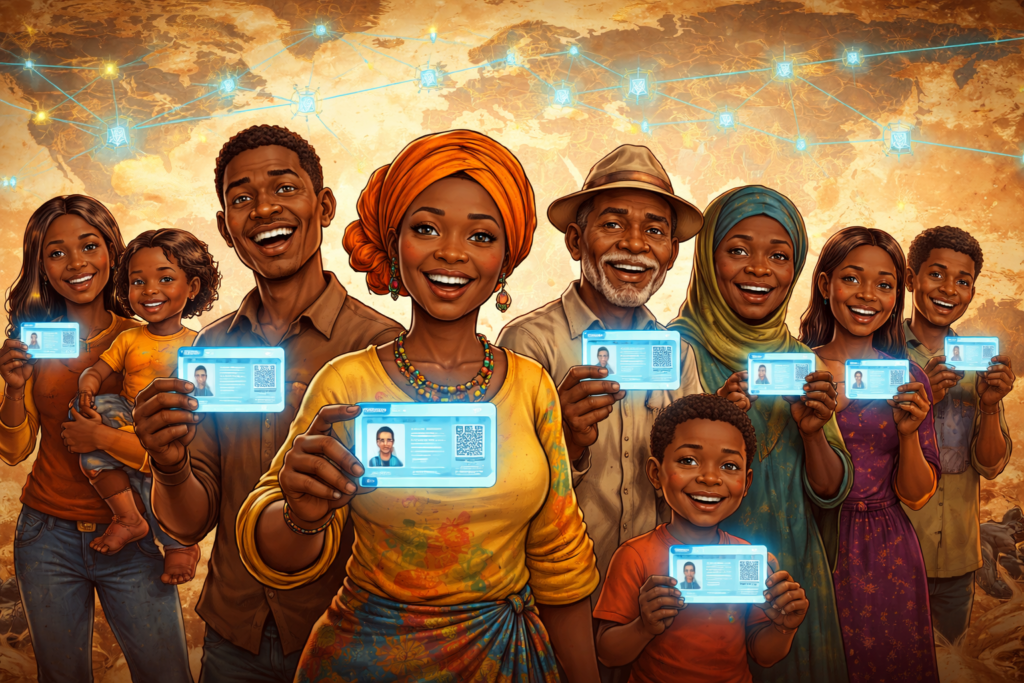
In simple terms, think of it as a digital version of your wallet — except instead of storing physical cards and documents, it stores verified, tamper-proof digital credentials that only you control. You decide who sees what, when, and for how long.
No physical papers to lose. No central database to be hacked or destroyed. No government office to visit — and definitely no lunch breaks that leave hundreds of people stranded in a queue.
Around 1 billion people worldwide currently lack a formal identity. SSI has the potential to solve this — enabling digital identities that can move between systems while maintaining verification, and guarding access to finance, education, and healthcare.
That is not a small number. That is a billion human beings effectively invisible to the systems that could help them.
How Blockchain Makes SSI Work
SSI does not exist in a vacuum — it is powered by blockchain technology, and understanding why matters.
The SSI ecosystem depends on blockchain technology for delivering integrity, security, and trustworthiness. Blockchain manages and stores decentralised identifiers and their connected metadata, letting users verify identity information in an unchangeable, transparent system that removes dependency on intermediaries.
What does that mean practically?
- Immutability — Once your identity credentials are recorded, they cannot be altered or erased. Not by a corrupt official. Not by a collapsed government. Not by a flood.
- Decentralisation — Your identity is not stored in one place that can be destroyed or hacked. It exists across a distributed network, always accessible to you.
- User control — You hold the keys. You decide what information to share, with whom, and when. No institution owns your identity data but you.
- Verifiability — Anyone who needs to verify your identity can do so instantly and cryptographically, without needing to contact the original issuing authority.
For a displaced person who has crossed three borders and lost every physical document they owned, these features are not technical luxuries. They are survival tools.
It Is Already Happening
This is not theoretical. The intersection of blockchain and digital identity is already being tested and deployed for displaced populations around the world.
UNHCR has been developing a blockchain-based digital ID system designed to safeguard the identity of displaced individuals while delivering financial aid to their digital wallets “within literally minutes” and “at zero cost.” The system relies on USDC stablecoins — widely accepted and easily exchangeable for local currency — meaning aid reaches people directly, without the layers of intermediaries that typically slow things down.
UNHCR has already tested its blockchain solution in war-torn Ukraine, winning the “Best Impact Project Award” at the 2023 Paris Blockchain Week. Check out the article here UNHCR wins award for innovative use of blockchain solutions to provide cash to forcibly displaced in Ukraine.
In Kenya, the sprawling Kakuma Refugee Camp has become one of the most referenced examples of technology-driven humanitarian innovation on the continent. As refugee settlements evolve into technologically driven hubs, the potential of blockchain technology to transform identity management and financial inclusion for displaced populations is becoming increasingly tangible.
In Zimbabwe, a startup called FlexID is using SSI to provide digital identity credentials to migrants and refugees — people who have long been excluded from formal financial and social systems simply because they could not prove who they were.
The solutions exist. The technology works. The question is how quickly and how equitably it can be scaled.
Beyond Refugees: Why This Matters for All of Us
It is easy to read a story about displaced populations and feel removed from it. But the principles behind blockchain and digital identity touch all of our lives more than we realise.
Think about the frustration of proving your identity to a new employer, a bank, a hospital, or a government office — digging up physical documents, waiting for verification, trusting that the institution storing your data is handling it responsibly.
Now think about a system where your verified credentials live in a digital wallet that only you control. Where you share exactly what is needed — and nothing more. Where your data cannot be stolen from a centralised database because it was never stored in one.
Self-sovereign identity embodies the fundamental human right to own and control a digital identity that grants access to public, social, and financial services. That is not just a refugee issue. That is a human issue.
And in a world where data breaches are routine, where identity theft costs individuals and institutions billions every year, and where billions of people remain excluded from formal systems entirely — the case for decentralised digital identity has never been stronger.
Blockchain Is About More Than Price Charts
There is a version of the blockchain conversation that lives entirely in the world of price charts, trading strategies, and “when Lambo?” memes.
This is not that conversation.
At its most meaningful, blockchain technology is about restoring something deeply human — dignity, agency, and access. It is about building systems that work for people, not just institutions. Systems that cannot be manipulated, corrupted, or simply closed for lunch when someone needs them most.
SSI is one of the most compelling examples of this. It takes a technology often associated with speculation and applies it to one of the most fundamental challenges of our time: the right of every person to prove who they are, regardless of what they have lost or where they have fled.
The blockchain infrastructure provides people with greater autonomy and control over their financial and personal data — and the combination of SSI and digital assets has the potential to enhance economic inclusion in ways that traditional systems have consistently failed to deliver.
Technology is at its best when it solves our most human problems. And this — giving the invisible a voice, the displaced a document, the forgotten a fighting chance — might be one of the most meaningful things blockchain has ever been used for.
Final Thoughts: The Person Behind the Document
Every conversation about blockchain and digital identity, every policy paper and pilot programme and technical white paper, ultimately comes down to a person.
A mother who cannot enrol her children in school because she has no proof of who she is. A young man who cannot access medical care because his documents were destroyed when his home was burned. A family that has been waiting years to be recognised by a system that was never designed to see them.
These are not edge cases. With over 117 million displaced people in the world today, they are a global reality — and one that demands better systems than paper documents and centralised databases that crumble under pressure.
Blockchain and digital identity, through tools like SSI, offer a real, working, scalable alternative. Not a perfect one — no technology ever is. But a meaningful one. One that puts control back where it belongs: in the hands of the individual.
Because identity is not just a document.
It is dignity.
If This Resonated With You
The broken systems we see in identity management are the same ones we see in healthcare, in payments, and in financial access across Africa. If you want to understand how blockchain is also transforming how we send and receive money across borders, this one is worth a read 👇
👉 Stablecoins for Freelancers and Businesses: A Better Way to Receive International Payments
And if the healthcare corruption angle caught your attention, go here next 👇
👉 Blockchain in Healthcare Africa: Why It Can No Longer Wait
The dots connect. Blockchain is not one story — it is many. And they all lead back to people.
Have you ever lost a vital document? How long did it take to replace it — and what did that process cost you? Share your experience in the comments. 👇