
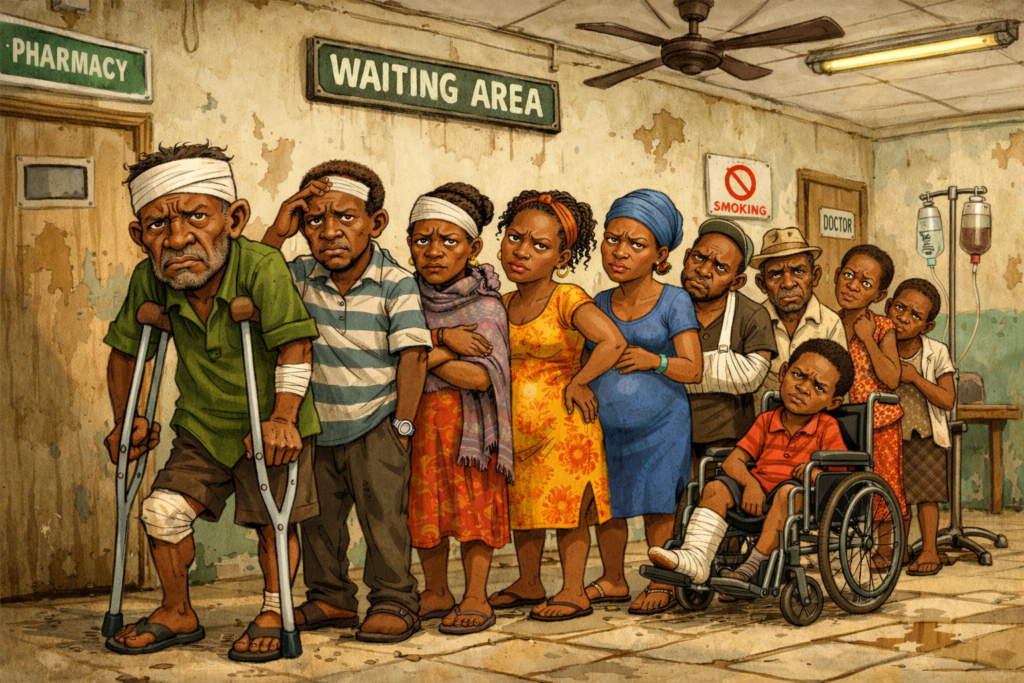
A Morning at the Hospital I Will Never Forget
Blockchain in healthcare Africa is a conversation that did not start in a boardroom for me. It started in a hospital queue.
Years ago, I walked into Kenyatta National Hospital very sick. Someone had told me the trick: arrive early if you want to see a doctor the same day. So by 6 a.m., I was already there , and to my surprise, I was not even among the first in line.
I waited five hours before seeing a doctor. In pain, but still hopeful to get treated the same day.
After the consultation, I was sent for scans and told to make payment through NHIF — our public health insurance at the time. I was directed to the NHIF desk inside the hospital.
Another queue.
I joined it, exhausted but holding on to the belief that the system I had been contributing to every single month would finally show up for me. When it was my turn, the officer looked up and said, “We are closed for lunch,” stood up, and walked away.
Hundreds of us were still in line.
I broke down and cried. 😭
Not just because of the pain. But because the system that was supposed to be there for me — simply wasn’t.
When Contributions Work, But Systems Don’t
What made that experience even more painful was the realisation that I had done everything right. My NHIF contributions were deducted on time, every month, without fail. On paper, the system was working exactly as it should.
But in reality? Access to care was slow, frustrating, and deeply uncertain.
This is a reality that millions of people across Africa understand too well. Public systems are often remarkably efficient when it comes to collecting funds. But when it is time to deliver services, the experience becomes inconsistent, long queues, missing records, delayed approvals, and unclear processes.
The problem is not always a shortage of money.
More often, it is a shortage of transparency, accountability, and the right systems to track how resources are actually used.
The Bigger Problem: When Billions Go Missing
Fast forward to today, and the conversations around Kenya’s Social Health Authority (SHA ) have brought all of this back into sharp focus.
SHA was introduced in October 2024 as a modern replacement for NHIF, promising universal health coverage for all Kenyans. The ambition was real. The results have been painful.
Reports revealed that SHA lost billions through healthcare fraud in just its first months of operation. Fraudulent claims included billings for surgeries performed multiple times on the same patient in a single day, and mothers recorded as delivering babies repeatedly across the same year. Funds that were meant to protect ordinary Kenyans , people like the ones standing in that queue with me, were stolen through a system with almost no way to detect or stop it.
But this is not just a Kenyan story.
Across many African countries, corruption and inefficiency in public systems continue to quietly drain resources that were meant to serve ordinary people. Funds earmarked for healthcare, education, and infrastructure disappear into opaque processes, weak oversight, and outright fraud. And the people who suffer most are always the same — the ones at the end of the queue, hoping the system holds.
Why Transparency Is the Missing Piece
At its core, this is not just a money problem. It is a trust problem.
People contribute to systems like NHIF and SHA because they believe those systems will protect them during their most vulnerable moments. But when there is no clear, accessible way to track how funds move, that trust begins to erode — slowly at first, then all at once.
Without transparency, some of the most basic questions become impossible to answer:
- Where is the money going?
- Who approved this transaction?
- Why was this claim delayed?
- Who is accountable when things go wrong?
When these questions have no clear answers, inefficiency thrives. And corruption becomes easier to hide.
Blockchain in Healthcare Africa: A Practical Solution
This is exactly where blockchain in healthcare Africa enters the conversation — and why it matters far beyond the world of cryptocurrency.
Most people hear “blockchain” and think Bitcoin. But the real power of blockchain technology lies in something much more practical: its ability to create systems that are transparent, traceable, and nearly impossible to manipulate.
Blockchain works as a distributed digital ledger, a shared record book held simultaneously across thousands of computers, with no single person or institution in control. Once information is recorded, it cannot be quietly altered or deleted. Every transaction leaves a permanent, visible trail.
Now imagine applying that to a public health insurance system.
Every contribution tracked. Every claim recorded. Every payment approved through a verified, tamper-resistant process. Every stakeholder — from the hospital to the regulator — accountable to a shared record that no one can edit after the fact.
This is what blockchain makes possible. The phantom surgeries and impossible births recorded in the SHA scandal would have been mathematically impossible to hide in a blockchain-based system. The fraud would have been visible in real time, not discovered months later in an audit report.
Blockchain does not eliminate every problem. But it closes the gaps that corruption quietly exploits.
The Four Pillars That Make It Work
Understanding why blockchain in healthcare Africa is so relevant comes down to four core features:
🔍 Transparency
Every transaction is visible to all authorised participants in real time. No hidden back channels. No invisible approvals. What goes in and what comes out is traceable by design.
🔒 Immutability
Once data is recorded on a blockchain, it is permanent. It cannot be edited, deleted, or quietly revised. This alone makes large-scale claims fraud dramatically harder to execute and easier to detect.
🌐 Decentralization
Traditional systems store data in one place, controlled by one authority — creating a single, convenient target for manipulation. Blockchain distributes that data across a network, meaning no single actor can corrupt or control the entire record.
🛡️ Security
Blockchain uses advanced cryptographic techniques to protect data. Unauthorised access is extraordinarily difficult, and any attempted breach is immediately visible to the network.
These are not futuristic concepts. They are direct, practical answers to the failures playing out in African healthcare systems today.
It Is Already Happening Across the Continent
This is not a distant possibility. Blockchain in healthcare Africa is already being tested and implemented.
In Tanzania, a pilot programme used blockchain to manage maternal health records, eliminating manual record-keeping at clinics, improving data security, and giving care providers instant access to accurate patient information.
In South Africa, the government’s National Health Insurance roadmap has explicitly cited blockchain technologies as tools to enhance efficiency, safeguard data security, and provide protection against corruption and fraud within the public health system.
The momentum is real. The solutions exist. What is needed now is the political will and investment to scale them.
Technology Alone Is Not Enough — But It Helps
It is important to be honest here: blockchain in healthcare Africa is not a magic solution. It will not fix everything overnight.
It cannot replace good governance. It cannot solve the chronic underpayment of healthcare workers. It cannot instantly rebuild decades of broken trust between citizens and public institutions.
But what it can do is make corruption significantly harder, more visible, and more traceable. It creates an environment where accountability is easier to enforce , where leakages are caught early, where records cannot be manipulated after the fact, and where ordinary citizens have a real chance of getting what they paid for.
When combined with strong regulation, responsible implementation, and genuine political commitment, blockchain in healthcare Africa can support:
- Better tracking of public health funds
- Reduced fraud in insurance claims
- Faster and more reliable service delivery
- Greater trust between citizens and institutions
That is not a small thing. In a context where billions are lost and patients are turned away, that is everything.
What We Must Not Forget
In the middle of all these conversations about technology and policy and governance, there is something we cannot afford to lose sight of.
The human experience.
Healthcare is not about systems or budget lines. It is about a person in pain, standing in a queue, hoping that the system they have been paying into will work when they need it most.
It is about dignity. About trust. About access.
My experience at that NHIF desk was not an isolated moment. It was a reflection of a much larger, ongoing failure — one that millions of people across Africa continue to live through every day.
That is what makes this conversation urgent. Not the technology itself, but the people it can protect.
Final Thoughts: Why This Conversation Matters
Conversations about blockchain, digital infrastructure, and health tech can feel distant and overly technical. But when you bring them back to a real person, standing in a real queue, in real pain — their importance becomes unmistakable.
This is not about innovation for the sake of innovation.
It is about building systems that actually work. Systems that are fair. Systems that are transparent. Systems that show up for people at their most vulnerable.
Africa has a genuine opportunity — not just to adopt technology, but to use it intentionally. To solve real problems. To restore trust. To close the gap between what public systems promise and what people actually experience.
Because at the end of the day, this is not really about blockchain.
It is about making sure that the next person who walks into a hospital — sick, hopeful, and counting on the system — does not have to stand in line wondering if it will fail them too.
The Same Technology, A Different Problem
What makes blockchain powerful in healthcare is exactly what makes it powerful in finance — transparency, security, and removing the middleman who slows everything down or makes things disappear.
If you have ever waited weeks for an international payment to reflect, watched fees eat into your earnings, or sat helplessly while a transfer was stuck “in progress,” you already understand why this technology matters beyond hospitals and government systems.
I wrote about this from a very personal place. 👉 Stablecoins for Freelancers and Businesses: A Better Way to Receive International Payments — because the same frustration I felt standing in that NHIF queue is the same frustration millions of Africans feel every time they try to move money across borders.
The system is broken in more ways than one. And blockchain is showing up in more places than you’d think.
Have you ever been failed by a public system you were counting on? Share your experience in the comments — these stories matter more than we realise.
Join me on YouTube: Here I share insights on tech, digital finance, and building a global career from Africa.