It Is Actually Happening?
Before I get into the five things, I want to share something that genuinely made my week.
I received a message from one of my YouTube subscribers — someone who had been watching my videos for a few months. She told me that after watching my content on remote work, she enrolled in an online course for medical virtual assistance, completed it in eight weeks, got approached on LinkedIn by a client, attended two interviews, and got the job.
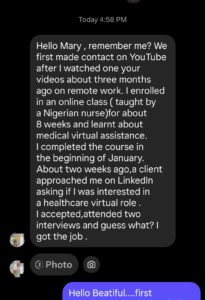
I read that message and I was so excited. Not because of anything I did, but because she took action. She watched, she learned, she built a skill, and she went and got it.
That is what this is all about.
So if starting your remote work journey in 2026 is on your vision board, written in your journal, or quietly living in the back of your mind — this blog is your nudge. Not tomorrow. Now.
Here are five things you need to start doing.
1. Stop Waiting for the Perfect Time
This is the one that gets most people stuck longer than anything else.
When I was working a 9-to-5 job that was slowly draining the life out of me, I knew I needed to make a change. But here is the thing — I did not have Wi-Fi at home. I did not have a personal laptop. The conditions were far from perfect.
So what did I do? I started going into the office two hours early every single morning to use the office laptop and office Wi-Fi to learn a new skill. Every day. Consistently. Until things changed.
Not having the ideal setup did not stop me. I refused to let it be the reason.
I say this because I hear the same excuses come up over and over again — “I don’t have a good laptop,” “my internet is not fast enough,” “I’ll start when things settle down.” There will always be something. The perfect moment is never coming. But the people who make it in remote work are not the ones who waited — they are the ones who started with what they had and figured the rest out along the way.
Whatever you have right now — a phone, a library with Wi-Fi, thirty minutes before bed — that is enough to start. You do not need perfect. You need to begin.
2. Invest in Proper Training — But Pick One Skill and Master It
Here is something nobody tells you about free online courses: they can become their own trap.
We live in an era of endless learning. YouTube tutorials, free certifications, Coursera, Udemy, LinkedIn Learning — the content is everywhere and most of it costs nothing. Which sounds amazing until you look up a year later and realise you have done fifteen courses, collected twelve certificates, and still have not landed a single remote job.
I call this being a professional student. You are always learning something, but never actually doing anything with it.
The goal is not to collect courses. The goal is to master one skill — deeply enough that someone will pay you for it. Pick one. Something you are genuinely interested in, something the market actually needs, and something you can see yourself getting really good at. Then invest real time in it. Build a strong foundation first. You can always layer on new skills later, but jumping between five different things at once will drain your energy and produce very little.
Deep subject matter expertise is now more important to companies than a broad, generalist skill set — and that shift matters. One excellent skill with real evidence behind it will always beat five half-developed ones on a CV.
3. Build as You Learn — Your Learning Must Produce Evidence
Let me be blunt about this one: knowledge you cannot prove means very little to a hiring manager.
You can tell someone you know social media management, copywriting, or video editing all day long. But what they actually want to see is the work. They want to look at something and say — okay, this person knows what they are doing.
When I finished my first web design course, I built my portfolio website. Was it beautiful? Absolutely not. I can still see the code and it makes me laugh. But it was evidence. It showed that I had taken what I learned and applied it to something real. And that mattered.
So whatever you are learning right now, build something from it. If you are learning video editing, create three or four sample videos and put them together as a portfolio. If you are learning digital marketing, run a small campaign — even for your own personal brand. If you are learning graphic design, create mock brand identities for imaginary businesses.
Your learning should produce evidence, not just words. The best path into remote work is proof of impact — a portfolio, case studies, or measurable outcomes from projects tends to beat a long CV. Employers hire people who can show what they have done, not just list what they have watched.
4. Learn a Skill That the Market Is Actually Paying For
This one is critical — and it is where a lot of people waste months or even years going in the wrong direction.
Before you go deep on any skill, ask yourself one honest question: who is going to pay me for this?
If you cannot answer that clearly, you need to rethink the direction.
The remote job market in 2026 is competitive, but it is also full of real opportunity for people who know what companies actually need. Engineering, administrative, and sales roles saw the largest gains in fully remote job postings in 2025, with social media, insurance, legal, and account management roles each expanding by 30% or more. Beyond tech, roles in content creation, digital marketing, virtual assistance, data analysis, and customer support continue to attract consistent remote hiring globally.
There is also something important to understand about AI right now. A lot of skills that were lucrative five years ago are being automated — or at least significantly disrupted. Web development is a good example. Five years ago it was a golden ticket. Today, AI can build a basic website in minutes. That does not mean the skill is dead — but it does mean you need to evolve with it. I still build websites, but now I build them using AI tools in ways that save clients time and produce better results. The skill did not disappear — it levelled up.
While some hard skills can be automated by AI, uniquely human power skills — including creative thinking, communication, and problem-solving — are increasingly attractive to employers as teams learn to work alongside AI tools. So whether you are technical or not, the goal is to find the intersection between what the market needs, what AI cannot easily replace, and what you can genuinely build expertise in.
The subscriber I mentioned at the beginning of this blog is a perfect example. She was a dental hygienist — a skill that does not immediately scream “remote work.” But she looked at what she already knew, identified how to position it for the remote market, did an eight-week online course in medical virtual assistance, and landed a job. She did not start from zero. She built on what she already had and pointed it in the right direction.
5. Surround Yourself With People Who Are Already Doing It
Your environment shapes your belief about what is possible — far more than most people realise.
Think back to when you were a child and someone asked what you wanted to be when you grew up. Chances are, your answers were limited to the people you had actually seen — teachers, doctors, pilots. You could only dream as far as you had seen. Remote work is no different.
If everyone around you is telling you remote jobs are a scam, or that it does not work for people in Africa, or that you need a foreign degree to compete — that becomes the ceiling on your ambition. But if you are consistently watching, following, and engaging with people who are actually living the remote life, your brain starts to accept it as a realistic option. And once it becomes real in your mind, it starts becoming real in your life.
Follow creators who are working remotely. Join online communities. Engage in LinkedIn conversations in your target industry. Attend virtual events and webinars. Clear written communication, self-management, and fluency with remote tools often matter as much as technical skill — and the best place to learn those things is by being around people who already embody them.
Be intentional about what you consume online. A rough rule that helped me: 90% of what you watch and engage with should be aligned to where you want to go. The other 10% can be comedy and memes — balance is important. But your feed should mostly be pulling you forward, not keeping you comfortable where you are.
The Bottom Line
Starting your remote work journey in 2026 is absolutely possible. The opportunities are real. The skills are learnable. The jobs are out there.
But it requires something most people are unwilling to do: start before you are ready, commit to one direction deeply, and keep showing up even when progress feels slow.
Five years ago, I had no laptop at home and no Wi-Fi. I did not even know where to begin. Today I work remotely, I have built a community, and I get messages from people like that subscriber telling me that things are changing for them too.
It was possible for me. It was possible for her. It is possible for you.
Stop wishing. Start doing.
Want to Go Deeper?
If you are serious about making this your year for remote work, this is worth reading next 👇
👉 Remote Work in Africa: How to Compete With Global Talent and Win
📖 Grab the Remote Work Guidebook — If you prefer something structured and practical, I wrote this guide specifically for people starting from scratch. It covers how to position yourself, pick the right skill, and land your first remote role with clarity and confidence.
Because knowing how to start is only half of it — understanding the global market you are stepping into is the other half. Go read it.
Are you currently working on your remote work journey? What is the one thing holding you back right now? Drop it in the comments — let’s talk about it.