
Kenya Wants Names. But Crypto Was Not Built That Way.
Crypto regulation in Africa just got its most concrete test yet and it is coming from Kenya’s Finance Bill 2026.
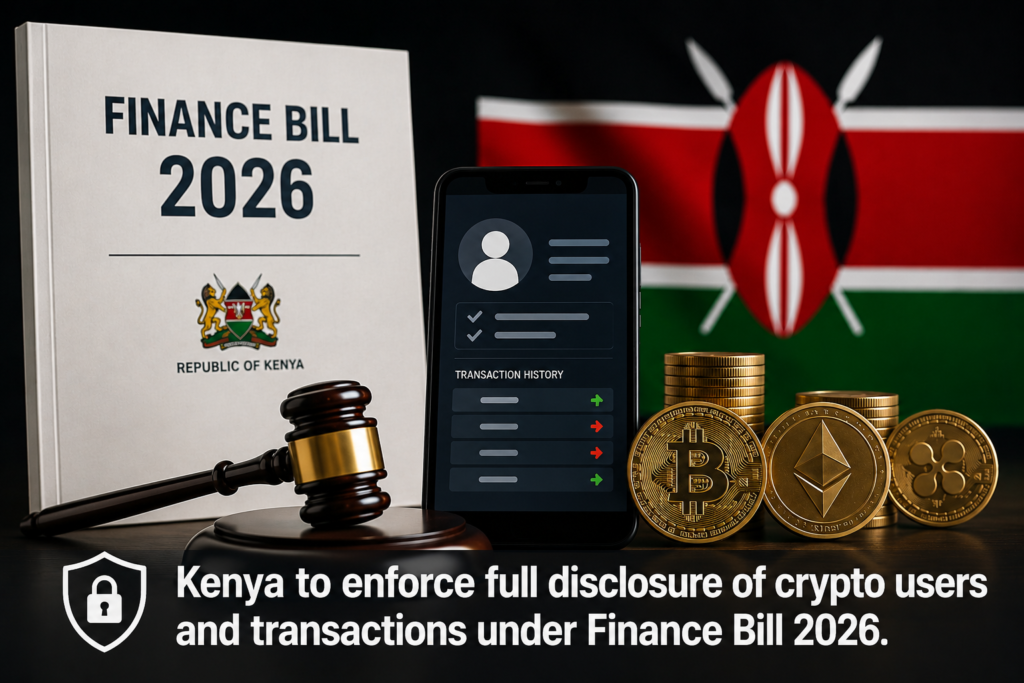
According to bill, Kenya will compel cryptocurrency exchanges and digital asset platforms to reveal the identities and transaction records of their customers in a sweeping new tax proposal that would sharply reduce anonymity in one of Africa’s most active crypto markets.
Under amendments to the Finance Bill 2026, currently before parliament, virtual asset service providers would be required to file annual returns with the Kenya Revenue Authority showing the names of Kenyan users, their transaction histories, and wallet activities. The bill introduces new Sections 6C and 6D to Kenya’s Tax Procedures Act, pulling the country’s crypto economy formally into the tax net. Providing false information would attract a KSh 100,000 fine per false entry, up to three years in prison, or both.
The stakes are real. The KRA estimates that Kenya processed approximately KSh 2.4 trillion in crypto transactions between 2021 and 2022 equivalent to nearly a fifth of the country’s GDP. That is not a small, informal corner of the economy. That is a significant financial ecosystem operating largely outside formal oversight. The government’s desire to bring it under regulation is entirely understandable.
But here is the honest conversation that needs to happen alongside this: the way the regulation is framed reveals a fundamental gap in how policymakers understand the technology they are trying to regulate.
The Problem: Not Every Wallet Has a Name to Give
To understand why this matters, you need to understand that the term “crypto wallet” covers two completely different realities.
Custodial wallets work similarly to a bank account. A centralised platform , an exchange like Binance or a local VASP holds the user’s cryptographic keys on their behalf. The platform knows who you are. They have your ID, your transaction history, your contact details. KYC is already built into how these platforms operate. These are exactly the platforms the Finance Bill 2026 is targeting and that targeting is reasonable.
Non-custodial wallets — also called self-hosted or unhosted wallets are an entirely different architecture. Here, the user holds their own private keys. There is no intermediary. No company stores their identity. No platform can freeze their funds, report their history, or verify who they are, because none of those functions exist in the system by design.
Unhosted wallets place private key management directly in the user’s hands without intermediary involvement. The wallet owner maintains complete control over their cryptographic keys and, by extension, their digital assets.
This is not a loophole. It is not a design flaw. It is a foundational feature of how blockchain technology works, and it is one that millions of Africans are already using daily. Regulatory actions in Nigeria, South Africa, and Kenya have at various points led to restrictions on exchange accounts and forced KYC processes, pushing more users toward self-custody tools precisely because holding your own keys means no platform can block access to your funds, regardless of regulators’ decisions.
When the Finance Bill 2026 compels VASPs to report user data, it can only reach the users who are already on those platforms. The users operating through non-custodial wallets, DeFi protocols, or peer-to-peer transactions are structurally outside that reach not because they are evading regulation, but because there is no intermediary to regulate.
Where Regulation Can Reach and Where It Cannot
This is the gap that crypto regulation in Africa consistently fails to reckon with honestly.
The only reliable point of regulatory intervention is where crypto intersects with the traditional financial system — specifically at fiat on-ramps and off-ramps. When someone buys crypto on a licensed exchange with Kenyan shillings, that exchange knows who they are. When they convert crypto back to fiat and send it to a bank account, that trail exists. Those are the regulated touchpoints.
Under the OECD’s Cryptoasset Reporting Framework that the Finance Bill 2026 mirrors, reporting obligations are imposed on VASPs rather than on owners of unhosted wallets themselves. Even the CFTC in the United States confirmed that some non-custodial providers do not have to register as intermediaries or enforce KYC when users trade directly a move that recognises that monitoring pure software is practically impossible.
Regulating a non-custodial wallet is comparable to trying to regulate a Ford for how its driver uses the road. The wallet does not hold or control user funds. It cannot freeze, reverse, or modify transactions. Developers do not act as intermediaries. There is simply no lever for a regulator to pull.
So when the Finance Bill 2026 compels VASPs to report wallet activity, the honest question becomes: whose wallet activity? Only the users who chose to use a licensed, centralised platform. The rest of the ecosystem, the DeFi users, the P2P traders, the self-custody holders remain outside the frame.
The Unintended Consequence Nobody Is Talking About
Here is the risk that aggressive crypto regulation in Africa creates — one that is almost never discussed in policy circles.
If centralised, licensed platforms become too expensive to operate, too burdensome to use, or too privacy-invasive for ordinary users, the rational response is not compliance. It is migration.
Users who feel over-surveilled, over-charged with compliance friction, or simply uncertain about data security will do exactly what the technology enables them to do: move fully into DeFi, return to peer-to-peer transactions, use non-custodial wallets exclusively, or simply avoid licensed platforms altogether.
And when that happens, the regulation achieves the opposite of its stated goal. The ecosystem that authorities can actually see and influence — the licensed, compliant, regulated one — shrinks. The one operating outside formal oversight gets larger. The tax revenues the KRA was hoping to capture move further from reach.
This is not a theoretical concern. Non-custodial wallets in 2026 have shifted from niche products to the foundation of crypto ownership for a growing segment of users — driven not by ideology but by practical concerns including exchange failures, account closures, and data breach anxiety.
Kenya is trying to position itself as Africa’s premier crypto hub, with approximately 50 virtual asset firms reportedly looking to set up regional headquarters in Nairobi. That ambition requires creating an environment where platforms choose to operate here — not one where compliance burdens drive activity offshore or underground.
What the Finance Bill Gets Right
To be fair — and fairness matters in this conversation — the Finance Bill 2026 gets several things right.
Tax accountability is legitimate. A crypto market processing KSh 2.4 trillion operating entirely outside the tax system is not sustainable. The principle that crypto gains should be taxed like other investment income is reasonable and aligns Kenya with how most mature markets approach digital assets.
The OECD alignment is strategically smart. By mirroring the Cryptoasset Reporting Framework, Kenya is plugging into a global information-sharing infrastructure that will see 40+ countries exchanging crypto tax data from 2027. For a country seeking to attract legitimate international crypto businesses, being part of that framework signals seriousness and predictability.
Focusing on VASPs rather than individuals is actually the right instinct. The CARF framework targets platforms, not individual wallet holders — and for good reason. Regulated intermediaries are where oversight is most achievable and most effective.
Penalties for false reporting create real accountability for platforms that might otherwise be tempted to file inaccurate or incomplete returns.
The architecture of the Finance Bill 2026 is not without merit. The concern is not the direction — it is the details, and specifically whether the people drafting these rules understand what VASPs can and cannot actually see.
What Smart Crypto Regulation in Africa Actually Looks Like
The goal is not to argue against regulation. The goal is to argue for regulation that works.
Several principles should guide how crypto regulation in Africa is designed — not just in Kenya, but across the continent as more countries build their frameworks.
Regulate the intersections, not the entire ecosystem. The most effective regulatory touchpoints are fiat on-ramps and off-ramps — the moments when crypto meets the traditional financial system. That is where identity is verifiable, that is where the paper trail exists, and that is where compliance is structurally achievable.
Use blockchain’s transparency as a tool. Public blockchains are by definition fully transparent. Every transaction is permanently and publicly recorded. Blockchain analytics tools already allow compliance teams to assess wallet risk, trace fund flows, and flag suspicious activity — without requiring every user to submit identification documents. Regulators who invest in understanding these tools will be more effective than those who rely solely on platform-based reporting.
Build proportionate, risk-based frameworks. A user transferring $10 in stablecoins to a family member is not the same risk profile as an institution moving $10 million cross-border. Regulation that treats them identically will be both disproportionate and counterproductive.
Engage the industry in building the rules. The Finance Bill 2026 was published on May 5, 2026, and is undergoing public participation. That window matters. Crypto stakeholders, developers, compliance professionals, and ordinary users all have insight into how the technology actually works — insight that policymakers need if the rules they write are going to be enforceable.
Africa’s Bigger Opportunity
Kenya is not alone in this journey. Ghana, Rwanda, South Africa, and Nigeria are all at various stages of building crypto regulatory frameworks. The decisions being made across these countries right now will collectively shape whether Africa leads in digital finance — or watches the innovation happen somewhere else.
The continent has a specific and compelling use case for getting this right. Crypto and stablecoins have been adopted widely across Africa not as speculation but as practical financial tools — for remittances, cross-border payments, and access to stable-value currencies in economies with volatile local exchange rates. These are use cases that disproportionately benefit the people who have historically been most excluded from formal financial systems.
Regulation that is built with a genuine understanding of how decentralisation works can protect those users, bring transparency to the ecosystem, and create the stable regulatory environment that serious businesses need to invest with confidence.
Regulation that treats blockchain like traditional banking infrastructure — assuming that intermediaries exist everywhere, that every wallet has an owner who can be compelled to identify themselves — will miss the mark. Not because the goals are wrong, but because the assumptions about the technology are.
Africa has a real opportunity to build smart, innovation-friendly crypto policies. But that only happens if the people writing the rules understand what they are actually regulating.
The Question Worth Sitting With
The Finance Bill 2026 represents Kenya’s most serious attempt yet to bring its crypto economy into the formal financial system. That seriousness deserves respect.
But the harder question — the one that the bill does not yet fully answer — is this: how do you create meaningful accountability in a system that was specifically designed to operate without central points of control?
The answer is not to pretend the technology works like a bank. It is to build regulatory frameworks that are honest about where oversight is achievable, creative about using blockchain’s own transparency as a compliance tool, and proportionate enough that users choose the regulated ecosystem rather than routing around it.
Crypto regulation in Africa is not a problem to be solved once and filed away. It is a conversation that will need to evolve as the technology evolves, as adoption grows, and as the gap between what regulators want and what is technically achievable becomes clearer.
The Finance Bill 2026 is not the end of that conversation. It is the beginning.
Continue Reading
This blog is part of an ongoing series on blockchain, digital assets, and regulation in Africa. These connect directly 👇
👉 Kenya VASP Regulations 2026: Are Local Builders Being Locked Out? — The regulatory framework behind the Finance Bill, and whether it creates room for local innovation.
👉 Web3 Careers in Kenya: What the CBK’s Crypto Hiring Signals — Because the people enforcing these regulations need to understand the technology first.
👉 Stablecoins for Freelancers and Businesses: A Better Way to Receive International Payments — The practical reason why crypto regulation in Africa matters for everyday people, not just institutions.
Where do you stand? Does Kenya’s Finance Bill 2026 strike the right balance — or does it risk pushing users further away from regulated systems? Drop your thoughts in the comments.