
Introduction
For many freelancers and small business owners working with global clients, the biggest challenge is not the work itself. The real headache often comes when it is time to get paid. International payments can be slow, expensive, and frustrating. Many professionals lose a significant portion of their earnings to transaction fees, while others experience long delays before their money finally reaches their accounts.
This is one of the reasons why the conversation around Stablecoins has become increasingly important. For those of us who depend on cross-border payments to run our businesses, financial systems that move slowly or charge excessive fees can directly affect our livelihoods.
Over the years, I have personally experienced the stress that comes with delayed payments and inefficient financial systems. Those experiences are exactly why discussions around digital finance and blockchain-based solutions resonate deeply with me.
The “10 Minutes” That Lasted a Week
I still remember one situation that perfectly captures the frustration many freelancers face when dealing with international payments.
At the time, I was expecting payment from a well-known online platform. I will not mention the name, but anyone who has worked with global freelance platforms probably knows how unpredictable payment processing can sometimes be.
My rent was overdue, and my landlord was already asking questions. Naturally, I kept checking the payment status in the app, hoping the money would reflect in my account soon.
Each time I refreshed the page, the same message appeared:
“Payment in progress. Your payment should arrive in 10 minutes.”
Ten minutes came and went. Then an hour. Then a day. Those ten minutes eventually turned into an entire week.
During that time, all I could do was wait and hope the system would finally complete the transaction. Thankfully the payment eventually arrived, but the experience left me thinking about how fragile the system can be for people who depend on timely payments.
For many people, delays like this are not just inconvenient. They can affect rent payments, bills, and business in general.
When Delays Cost More Than Money
Another experience that reinforced this reality happened recently with a close friend of mine.
She had imported goods from China on behalf of a client and was waiting for financing to finalize the transaction. One Friday evening, we met for a drink, and during our conversation she suddenly broke down in tears.
She told me, “Mary, if this order delays for even another month, my client has the right to cancel the order and I will be fined.”
The pressure she was under was immense.
The person who was supposed to send the financing had promised to transfer the money that same Friday. Unfortunately, because it was the weekend, the transfer would only reflect in her account sometime between Tuesday and Wednesday the following week.
As we all know, traditional banks typically do not process international transfers over the weekend.
Once the money arrived, she would still need to wire it to China for the supplier to release the consignment. That meant additional delays, additional fees, and additional uncertainty.
In situations like this, time is everything. Delays can disrupt entire supply chains and affect relationships between businesses and their clients.
Seeing her go through that made me angry. It made me mad that in 2026, a tedious, outdated payment method could potentially ruin a hard-working woman’s business. What made the situation even more frustrating was the realization that most of the stress she was experiencing came from inefficient payment systems.
Why the Conversation Around Digital Finance Matters
Experiences like these are the reason I feel so strongly about conversations around digital finance and blockchain-based payment systems.
For many people in Africa, financial infrastructure still presents serious challenges. Whether you are a freelancer, entrepreneur, or importer/exporter, moving money across borders can be unnecessarily complicated.
High transaction fees, slow processing times, and limited banking hours all create friction for people who are trying to operate in a global economy.
This is exactly where blockchain technology and digital assets begin to offer interesting possibilities.
Understanding Stable coins and Their Role in Payments
One of the most promising developments in this space is the rise of stablecoins.
Unlike traditional cryptocurrencies that experience high volatility, stablecoins are designed to maintain a stable value by being pegged to fiat currencies such as the US dollar.
This means users can benefit from the advantages of blockchain technology without worrying about dramatic price fluctuations.
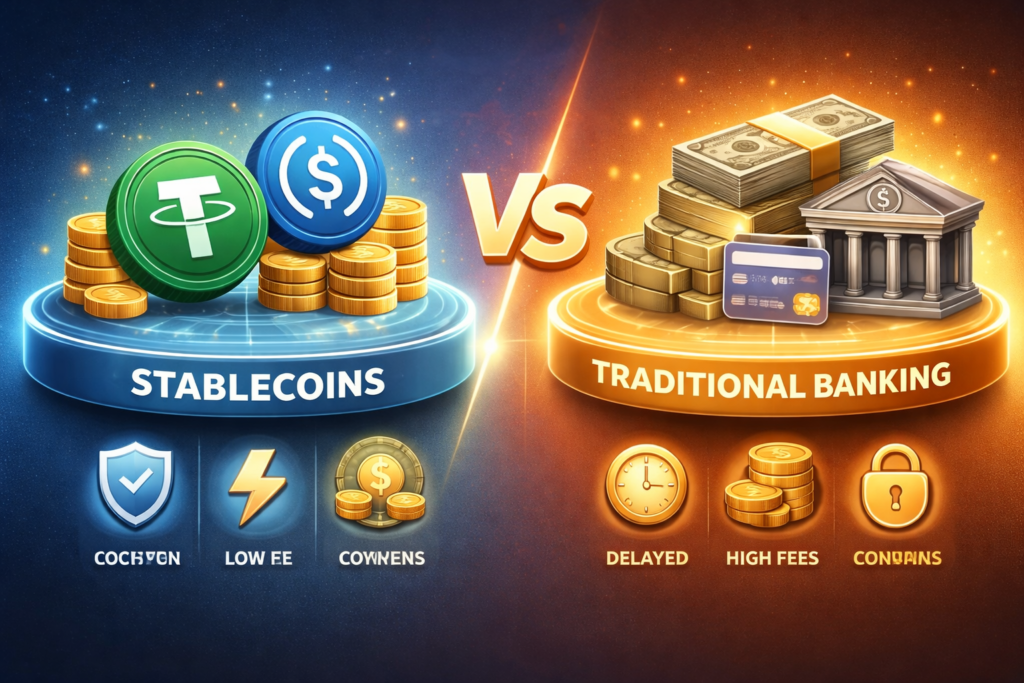
For freelancers and business owners, stablecoins can potentially offer several advantages:
- Faster cross-border payments
- Lower transaction fees
- 24/7 transfers that are not restricted by banking hours
- Greater accessibility for people in emerging markets
These features make stablecoins particularly attractive in regions where traditional financial systems can be slow or expensive.
Seeing Real Solutions in Action
Recently, I had the opportunity to speak at an event organized by TechRift Africa where the conversation focused on the practical applications of digital finance in Africa.
The event brought together different stakeholders who are actively building solutions in the blockchain and fintech ecosystem.
What stood out the most was seeing companies demonstrate real-world applications of stablecoins in everyday financial transactions.
Teams from Busha and Kotani Pay showcased how their platforms enable users to send and receive payments using stablecoins in a simple and accessible way.
Instead of dealing with multiple intermediaries and lengthy banking processes, users can transact directly through blockchain-powered platforms.
Watching these demonstrations made one thing very clear: the technology is no longer theoretical. Practical solutions are already being built.
Why Africa Could Benefit the Most
Africa is uniquely positioned to benefit from innovations in digital finance.
Many countries across the continent already lead the world in mobile money adoption. People are comfortable using digital tools to send and receive payments, which creates a strong foundation for new financial technologies.
As regulatory frameworks continue to evolve, stablecoins could play an important role in improving financial accessibility and efficiency.
For freelancers, entrepreneurs, and small businesses working across borders, stablecoins may eventually provide a faster and more affordable alternative to traditional banking systems.
Most importantly, these technologies have the potential to empower the everyday citizen — the common mwananchi — by giving them more control over how they send, receive, and manage money.
Final Thoughts
For many freelancers and entrepreneurs, financial systems are more than just infrastructure. They directly affect our ability to work, grow businesses, and support our livelihoods.
Delayed payments, high fees, and limited banking hours create unnecessary barriers for people who are already navigating the challenges of working in a global economy.
That is why conversations around digital assets, blockchain, and stablecoins are becoming increasingly relevant. Stablecoins aren’t just a tech trend—they’re a practical solution for freelancers and businesses who work international clients. If you want to learn more about how I structure my remote work life and earn from international clients, dive into my journey here: Life as a Remote Worker in Kenya.
While the technology is still evolving, solutions that make payments faster, cheaper, and more accessible could transform how freelancers and businesses operate across borders.
If these innovations continue to mature, they may help create a financial system that truly works for everyone.
Continue the Conversation
Financial innovation is moving quickly, and conversations around blockchain and digital finance are becoming more important every day.
If you are interested in topics like:
- remote work and global freelancing
- the realities of working in tech
- digital finance in Africa
I regularly share insights and experiences from my journey.
🎥 Join the conversation on YouTube:
Subscribe for weekly discussions about tech, career growth, and navigating the digital economy.
💬 What has been your biggest challenge with international payments?
Have you experienced delays or high fees when working with global clients?
Share your experience in the comments. Your story might help someone else understand they are not alone.